 Din Lligwy
Just for a moment pretend you're living about 1,700
years ago. Your granddad kept you awake when you were little by
telling you tales of a strange people who had marched out of the
East and conquered your homeland. No matter how often the defenders
of the island had tried to stop them, no matter how hard the priests
had prayed at the sacred groves or how many sacrifices were made,
there was no stopping them. And now, 250 or so years later, it
didn't seem so bad after all. If fact, one of them lived just
down the road, in a smart new house that was actually warm in
winter and where people actually washed! Not a bit like where
you live but then again, you like living in the old way, even
though your settlement has only just been built. Built in the
historic way, round huts to live in, with stone foundation walls,
wooden sides and turf roofs. And square huts, where the animals
were kept and which were also used as workshops. It's raining,
and you're standing in the doorway of one of these huts, getting
ready to light the fire in the hearth, for today is a smelting
day when the iron will be made.
Din Lligwy
Just for a moment pretend you're living about 1,700
years ago. Your granddad kept you awake when you were little by
telling you tales of a strange people who had marched out of the
East and conquered your homeland. No matter how often the defenders
of the island had tried to stop them, no matter how hard the priests
had prayed at the sacred groves or how many sacrifices were made,
there was no stopping them. And now, 250 or so years later, it
didn't seem so bad after all. If fact, one of them lived just
down the road, in a smart new house that was actually warm in
winter and where people actually washed! Not a bit like where
you live but then again, you like living in the old way, even
though your settlement has only just been built. Built in the
historic way, round huts to live in, with stone foundation walls,
wooden sides and turf roofs. And square huts, where the animals
were kept and which were also used as workshops. It's raining,
and you're standing in the doorway of one of these huts, getting
ready to light the fire in the hearth, for today is a smelting
day when the iron will be made.
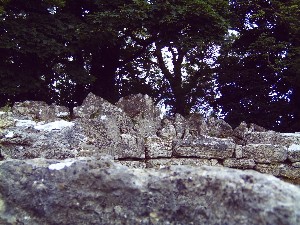
It's 2003, it's still raining, and you're standing in the same
doorway! Not much has changed, although the wooden walls and the
turf roofs have gone. The huts are still here however, along with
the defensive perimeter wall. A few more trees perhaps, but basically
just the same. Around you are the nine huts of the 4th century
Romano-British settlement of Din Lligwy. The whole site covers
about .2 of a hectare, not very big by our standards but home
to perhaps 50 or so people at the time. Two of the square huts
have been found to have 6 smelting hearths in them, so ironworkers
obviously lived here. Built towards the end of the Roman occupation
of Britain it probably didn't last for all that long, maybe a
couple of hundred years, but it is in remarkable condition considering
the length of time it has stood. Not much of the stone has been
robbed out; in fact some of the walls are up to 6 feet high in
places.
Worth a visit, as you get a real sense of how people lived in
those days. Come through the wall at the northeast gateway and
the village opens up in front of you. Wander around the open space
in the middle and go inside the huts. Imagine what it was like
to live in such a confined space, with all your animals herded
inside at night. Imagine defending the walls against raiders,
once the Romans had left and other invaders came. Then go down
to Moelfre and have a pint in the Kimnel Arms!
To get to Din Lligwy follow the A 5025 through Benllech
until you get to the Moelfre roundabout. Instead of turning right
to Moelfre or left to Amlwch go straight across towards Lligwy.
Pass the Lligwy burial chamber on your left (where the remains
of 30 Neolithic skeletons were found) and look for the parking
place on the left. Go over the style and across the fields keeping
to the left to come to the outer wall of the settlement. You can
also see the remains of the Hen Capel, a 7th century church on
the right.